Medical bills are confusing, rushed and often wrong, and the error is almost never in your favor. Medical billing errors can add up to real money, from a duplicated charge to a service you never received.
The good news: most mistakes are easy to catch once you know where to look, and fixing them usually takes a phone call or two.
Quick answer: To spot medical billing errors, get an itemized bill, compare it to your insurer’s Explanation of Benefits (EOB), and check for duplicate charges, services you didn’t receive, wrong codes, out-of-network surprises and math mistakes. Dispute errors in writing, ask for a payment hold, and keep records. Savings vary widely, but even one corrected line can be worth tens to thousands of dollars.
Why medical billing errors happen so often
A single visit can generate bills from the hospital, the doctor, the lab, the radiologist and the anesthesiologist. Each one uses billing codes, which are short numbers and letters that describe what was done. A typo, a copied entry or a mismatch between systems can change what you owe.
Insurers add another layer. They process the claim, apply your deductible and copay, and send you an EOB, which is a statement explaining what they covered. It is not a bill, but it is your best tool for checking the real one.
You don’t need to be an expert. You just need the right documents and a little patience.
The documents you need before you start
Gather these three things before you dig in:
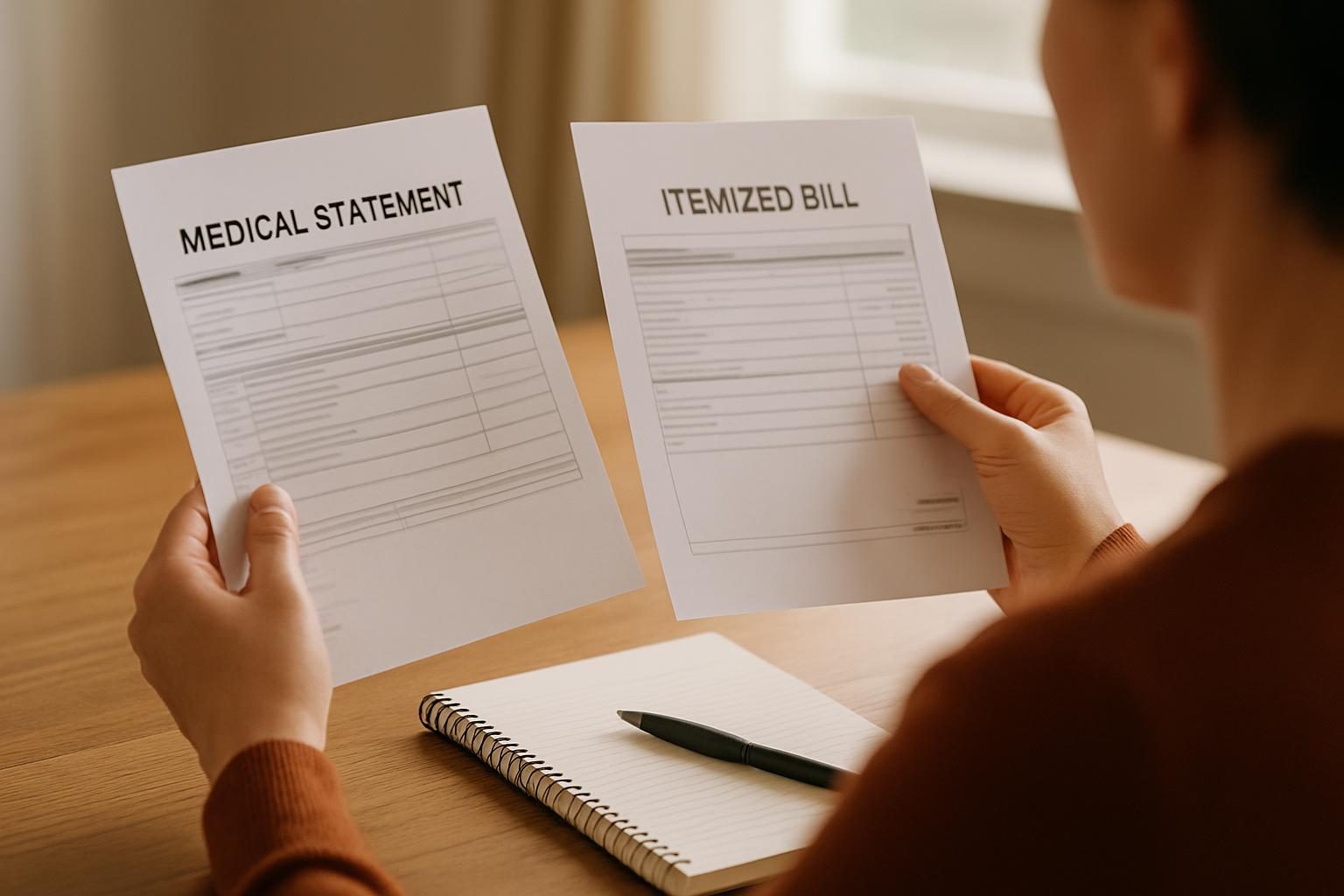
- The itemized bill from the provider, listing every charge separately. A summary statement with one lump sum is not enough. See our guide to requesting and reading an itemized medical bill.
- Your EOB from your insurance company for the same date of service.
- Your own notes on the visit: dates, what was done, who you saw and any paperwork you signed.
If you don’t have an itemized bill yet, call the billing office and say: “Please send me a fully itemized bill with procedure codes for date of service [date].” They are generally expected to provide it, and it is usually free.
A summary bill hides mistakes. An itemized bill shows them.
The most common medical billing errors
1. Duplicate charges
The same test, procedure or supply appears twice, sometimes on the same day. This happens when an order is entered twice or when two departments bill for the same thing. Scan for repeated lines with identical descriptions and amounts.
2. Charges for services you never received
A lab test that was ordered but never run, a room upgrade you didn’t get, or a medication that wasn’t given can all land on the bill. Compare each line to your own notes and to what you remember.
3. Wrong billing codes (upcoding and unbundling)
Upcoding means a service is billed at a higher level than what was provided, such as a routine visit coded as a complex one. Unbundling means a package of services that should be billed together is split into separate, pricier pieces. You can’t always catch these yourself, but you can ask the billing office to explain any code you don’t understand and to have a coder review it.
4. Insurance billed incorrectly or not at all
Sometimes a provider has your old insurance information, a typo in your member ID, or never submitted the claim. You then get a bill for the full amount. Check that the EOB exists and matches the provider’s bill.
5. Out-of-network charges you shouldn’t owe
Getting a surprise bill from an out-of-network provider after care at an in-network facility is a major source of disputes. Federal rules under the No Surprises Act protect patients in many of these situations, including most emergency care and some services at in-network hospitals. Read the No Surprises Act explained in plain English, and confirm current details with the Centers for Medicare & Medicaid Services (CMS).
6. Wrong deductible, copay or coinsurance
The provider may apply your cost-sharing incorrectly, or bill you for an amount your insurer already counted. Compare the “patient responsibility” amount on your EOB to what the provider is asking.
7. Billing for preventive care that should be free
Many insurance plans cover certain preventive services at no cost to you when coded correctly. If a routine screening shows up as a charge, ask whether it was coded as preventive or diagnostic, since that can change what you owe. Check your plan documents or call your insurer to confirm what is covered.
8. Math and data-entry mistakes
Wrong dates, misspelled names, incorrect quantities (10 units instead of 1) and simple arithmetic errors are surprisingly common. Check dates of service, quantities and totals line by line.
Common errors at a glance
| Error type | What it looks like | Where to check |
|---|---|---|
| Duplicate charge | Same item listed twice | Itemized bill |
| Service not received | Test, drug or room you don’t recall | Your notes, medical record |
| Upcoding or unbundling | Complex code for a simple visit; split packages | Billing codes, EOB description |
| Insurance not billed | Full price bill, no EOB | Insurer’s claims portal |
| Out-of-network surprise | Provider at in-network facility bills higher rate | EOB, network directory |
| Wrong cost-sharing | Patient amount doesn’t match EOB | EOB vs. provider bill |
| Data-entry mistake | Wrong date, quantity or total | Itemized bill |
How to check your bill step by step
- Request the itemized bill. Call the billing office and ask for every charge with codes and dates.
- Get your EOB. Log into your insurer’s portal or call member services. Make sure the EOB is for the same date of service.
- Match them line by line. Every charge on the bill should appear on the EOB. Note anything that doesn’t.
- Mark suspicious lines. Highlight duplicates, services you didn’t get, and amounts that don’t match.
- Check the basics. Confirm your name, insurance ID, dates and quantities are correct.
- Call the billing office. Use the script below, ask for corrections, and get the name of the person you spoke with.
- Follow up in writing. Send a short letter or portal message summarizing the dispute and asking for a corrected bill and a hold on collections.
What to say when you call
Keep it calm, specific and polite. Here is a script you can adapt:
“Hi, I’m reviewing my bill for date of service [date], account number [number]. I found a charge for [item] on [line] that I believe is a duplicate/that I did not receive/that doesn’t match my insurance EOB. Can you review it and send me a corrected, itemized bill? Also, can you place my account on hold while this is reviewed? I’d like to confirm that in writing.”
Write down the date, time, name and any reference number. If the first person can’t help, politely ask for a supervisor or a patient advocate. For more phrasing, see our negotiation scripts, timing and tactics and our medical bill negotiation letter template.
Always ask for the correction in writing, and always ask for a hold on collections.
Money move: Before you pay any large medical bill, ask for the itemized bill and your EOB, then match them line by line. Even a single duplicate or miscoded charge can be worth tens to thousands of dollars, and it costs you nothing to check.
What if the provider won’t fix it?
If the billing office pushes back, you still have options.
Escalate inside the system
Ask for a supervisor, the hospital’s patient advocate or the compliance department. Many hospitals have staff whose job is to resolve billing disputes.
Appeal with your insurer
If the problem is that your insurer denied or underpaid a claim, you have the right to appeal. Follow our guide on how to appeal an insurance claim denial.
Contact a regulator
Your state insurance department can help with insurer problems, and your state attorney general’s consumer protection office can take complaints about billing practices. For surprise billing issues, CMS operates a federal help line and complaint process; confirm the current details on CMS.gov.
Ask about financial help
Even when the bill is correct, you may qualify for a discount. Many nonprofit hospitals are required to have financial assistance policies. See how to apply for hospital financial assistance and win, and use our step-by-step guide to negotiating medical bills for the next moves.
Protect yourself going forward
- Keep records. Save paperwork, take notes during calls and photograph documents.
- Ask for estimates. Before planned care, ask the provider and your insurer for a cost estimate and confirm network status.
- Check your credit-related rights. If a disputed bill goes to collections, learn the rules in our medical debt and credit report guide.
- Look at related costs. Prescriptions and dental care have their own billing quirks; see our upcoming guides on how to lower your prescription costs and how to lower dental bills.
Struggling to pay even after fixing errors? Our 9 steps if you can’t pay medical bills and our guide to asking for a 0% interest payment plan can help. You can also browse more guides in our Medical Bills category.

When to ask for help
If a bill is large, the dispute is dragging on or you feel out of your depth, outside help can be worth it. Some hospitals and nonprofits offer free patient advocates or financial counselors. Calling 211 can connect you with local assistance, and Benefits.gov can point you to programs you may qualify for.
Be cautious with paid billing advocates: ask what they charge, whether it is a flat fee or a percentage of savings, and get terms in writing. Never feel pressured to sign anything on the spot.
Think your medical bill is too high?
Tell us what you pay now and we will follow up with ways to lower it, from do-it-yourself steps to vetted partner offers. Free, with no obligation.
Thanks, we have it.
We will look at what you pay and follow up soon. Meanwhile, try our free negotiation script builder.
Key takeaways
- Always request an itemized bill and compare it to your insurer’s EOB before paying.
- The most common errors are duplicates, services not received, wrong codes, insurance mistakes and out-of-network surprises.
- Dispute errors by phone, then follow up in writing and ask for a hold on collections.
- Escalate to a patient advocate, your insurer or a state regulator if the provider won’t fix it.
- Even correct bills may be reduced through financial assistance, negotiation or a payment plan.
- Keep detailed records of every call, name and document.
Frequently asked questions
How common are medical billing errors?
Errors are common enough that checking every bill is worth your time. Exact rates vary by provider and by study, so rather than trusting a single number, treat every bill as something to verify. A 15-minute review against your itemized bill and your insurer’s Explanation of Benefits can catch problems before you pay.
Who do I contact first if I find an error?
Start with the provider’s billing office, since most mistakes are fixed there. Have your account number, the date of service and the specific line items ready. If the error involves what your insurance paid or denied, call your insurer’s member services too. Ask for a corrected bill in writing.
Should I pay a bill I’m disputing?
Ask the billing office to put your account on hold while the dispute is reviewed, and ask them to confirm that hold in writing or by noting it in your account. Paying a bill you believe is wrong can make it harder to get money back. If you can’t get a hold, ask a state consumer protection office or your state insurance department what your options are.
Can a billing error hurt my credit?
It can if the bill goes to collections while the error is unresolved. Dispute in writing quickly and keep copies of everything. The rules on how medical debt appears on credit reports have changed over the years, so check our guide to medical debt and credit reports and confirm current rules with the Consumer Financial Protection Bureau.
What if the hospital says the bill is correct but I still think it’s wrong?
Ask for a supervisor or a patient advocate, and request a written explanation of each charge you question. You can also file an appeal with your insurer if the issue is a denial, or contact your state insurance department or attorney general’s consumer protection office for help. Keep a log of every call with dates, names and what was said.